



 Fenny Gandhi
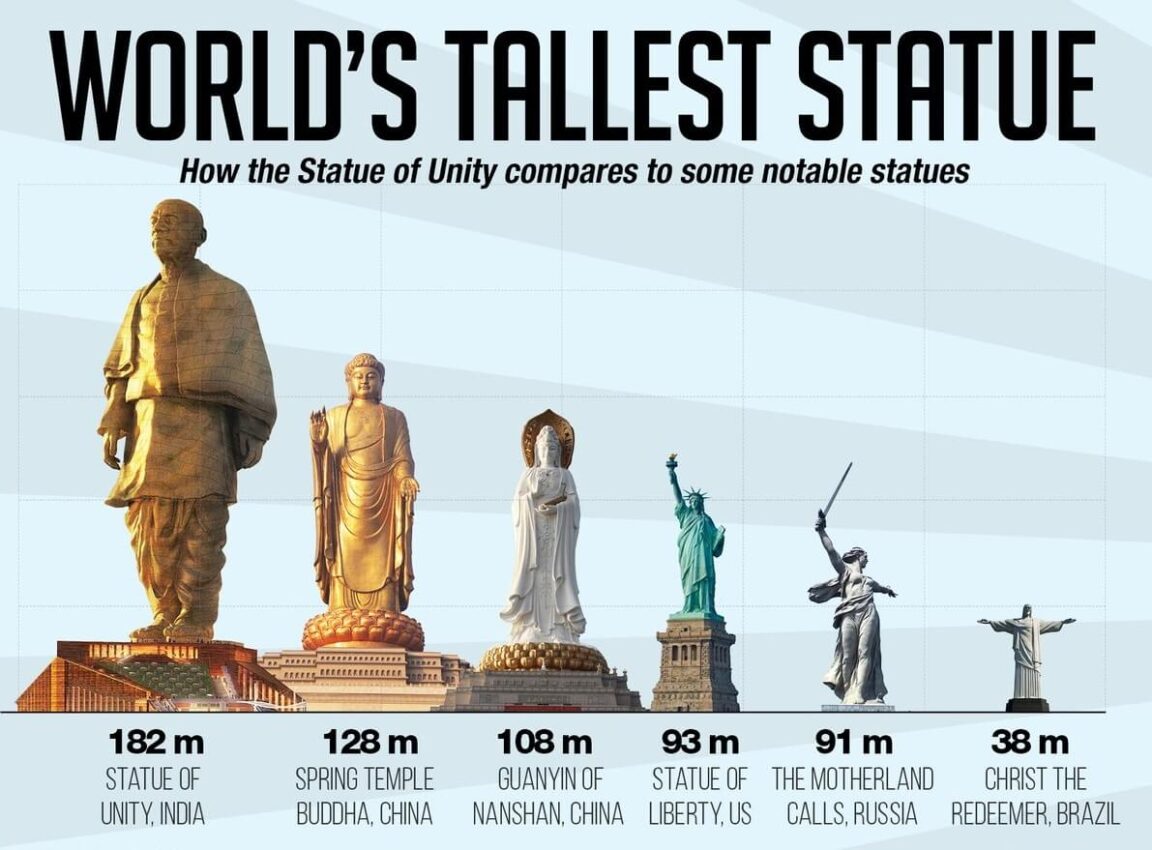
The Statue of Unity, standing at a staggering 182 meters (597 feet) in the Indian state of Gujarat, holds the distinction of being the tallest statue in the world. This colossal monument honors Sardar Vallabhbhai Patel, India’s first Deputy Prime Minister and the leader credited with unifying the country’s 562 princely states into a single nation after independence in 1947. Since its inauguration on October 31, 2018, the Statue of Unity has become one of India’s most visited landmarks and a symbol of national pride and engineering achievement.
Design and Construction
The statue was designed by Indian sculptor Ram V. Sutar and his son Anil Sutar. The design depicts Sardar Patel in a standing position wearing traditional Indian clothing, with a posture that conveys determination and forward momentum. The figure faces the Narmada Dam, symbolically looking toward the future while standing firmly rooted in India’s history. At 182 meters, it is nearly twice the height of the Statue of Liberty (93 meters including its pedestal) and significantly taller than the previously record-holding Spring Temple Buddha in China (153 meters).
The construction project was massive in scale and ambition. Larsen and Toubro, one of India’s largest engineering and construction firms, won the contract and assembled a workforce that peaked at approximately 3,000 workers. The construction took 33 months, from October 2014 to October 2018, and cost approximately 27 billion Indian rupees (roughly $430 million at the time). The project used 1,700 tonnes of bronze, 18,500 tonnes of reinforced steel, and 180,000 cubic meters of concrete, along with 6,500 tonnes of structural steel for the internal framework.
Engineering Challenges
Building the world’s tallest statue presented unprecedented engineering challenges. The statue had to withstand wind speeds of up to 180 kilometers per hour, seismic activity up to magnitude 6.5 on the Richter scale, and the erosive effects of weather on its bronze exterior. Engineers designed a complex internal structure consisting of two massive concrete cores connected by steel trusses, creating a rigid framework that supports the bronze cladding while allowing for thermal expansion and contraction.
Related Reading
The bronze panels that form the statue’s exterior were manufactured in a foundry in China (a detail that generated some domestic controversy) and shipped to India for assembly. Each panel was precision-engineered to fit its specific location on the statue’s surface, with tolerances measured in millimeters despite the enormous overall scale. The panels are designed to develop a natural patina over time, similar to the Statue of Liberty’s famous green color, though the Statue of Unity’s bronze composition will age with a slightly different hue.
The Visitor Experience
The Statue of Unity is more than just a monument – it is a comprehensive tourist destination. An observation gallery located at 153 meters height (in the statue’s chest area) offers panoramic views of the Narmada Dam, the Satpura and Vindhyachal mountain ranges, and the surrounding Kevadia region. The gallery can accommodate 200 visitors at a time, who reach it via high-speed elevators that travel from the base to the viewing level in under a minute.
At the statue’s base, visitors can explore the museum and exhibition hall, which provides detailed information about Sardar Patel’s life, his role in India’s independence movement, and his monumental achievement of unifying India’s princely states. The surrounding area has been developed into a tourist zone featuring a Valley of Flowers garden, a tent city for overnight stays, river rafting on the Narmada, a jungle safari, and a light and sound show projected onto the statue itself during evening hours.
Sardar Patel’s Legacy
Sardar Vallabhbhai Patel (1875-1950) is one of the most significant figures in Indian history. As India’s first Home Minister and Deputy Prime Minister, he undertook the seemingly impossible task of convincing or compelling 562 autonomous princely states to join the newly independent Indian Union. Through a combination of diplomatic persuasion, political strategy, and, when necessary, military pressure, Patel succeeded in creating a unified India within just two years of independence – an achievement that many historians consider as important as the independence struggle itself.
Known as the “Iron Man of India,” Patel’s legacy of national unity makes him a particularly meaningful subject for what has become a symbol of modern India’s ambition and capability. The Statue of Unity represents not just one man’s legacy but an entire nation’s journey from colonial fragmentation to unified sovereignty, standing as a reminder that extraordinary achievements are possible when diverse peoples work together toward a common vision.




One Comment